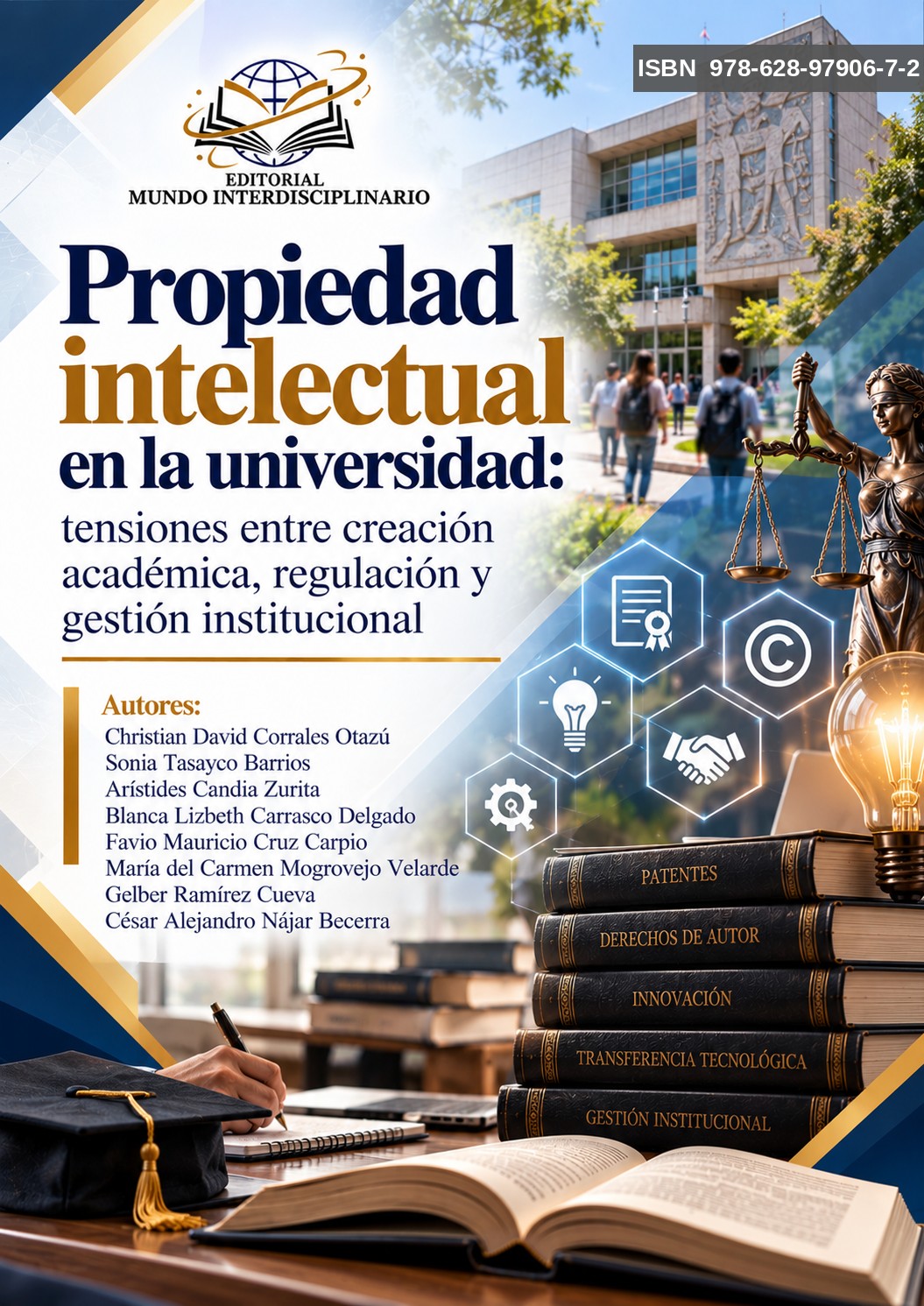
Propiedad intelectual en la universidad Tensiones entre creación académica, regulación y gestión institucional
Article Sidebar
Main Article Content
Abstract
Este libro ofrece un análisis sociojurídico de las tensiones que atraviesan la propiedad intelectual en la universidad, entre la creación académica de docentes e investigadores, la regulación jurídica aplicable y la gestión institucional de los resultados de investigación, con especial atención al caso peruano. Examina cómo el modelo continental europeo de derecho de autor, centrado en la persona creadora, convive con las presiones de transferencia tecnológica y capitalización del conocimiento, y cómo la Ley Universitaria N.° 30220, al no resolver de forma expresa la titularidad de los resultados de investigación, deja que cada universidad regule el tema mediante reglamentos internos de calidad desigual. La obra se organiza en cuatro capítulos: la configuración del problema jurídico-institucional; los fundamentos doctrinarios y el marco normativo (derecho de autor, derechos conexos y patentes); el diseño metodológico cualitativo, interpretativo y crítico; y un diagnóstico de la eficiencia normativa e institucional frente a la inteligencia artificial generativa, la ciencia abierta y los repositorios digitales. Su propósito es aportar bases conceptuales para un modelo de gobernanza del conocimiento que proteja los derechos de los autores, garantice la sostenibilidad institucional y preserve la función pública de la ciencia.
Downloads
Article Details

This work is licensed under a Creative Commons Attribution-NonCommercial-ShareAlike 4.0 International License.
This journal is licensed under a Creative Commons Attribution-NonCommercial-ShareAlike 4.0 International License (CC BY-NC-SA 4.0). The guiding principle of Creative Commons licenses is creative freedom. This system complements copyright law without opposing it, recognizing its importance within our culture. The content of the articles is the sole responsibility of each author and does not, in any way, commit the journal or the institution. The dissemination and reproduction of titles, abstracts, and full content are permitted for academic, scientific, and cultural purposes, provided that the corresponding source is properly cited. This work may not be used for commercial purposes.

References
Alvarado, M., & Supo, D. (2021). Blockchain y propiedad intelectual: aplicando una tecnologia innovadora en la gestion de derechos intangibles. THEMIS: Revista(79), 345-357. doi: https://doi.org/10.18800/themis.202101.019
Arrow, K. (1962). Economic Welfare and the Allocation of Resources for Invention. En N. R., The Rate and Direction of Inventive Activity: Economic and Social Factors (págs. 609–626). Princeton University Press. Obtenido de https://scholarship.law.duke.edu/cgi/viewcontent.cgi?article=1362&context=dlj
Bently, L., & Sherman, B. (2014). Intellectual Property Law. Oxford University Press.
Bercovitz, R. (2019). Manual de propiedad intelectual (9.a ed.). Tirant lo Blanch.
Betancur, M. C., & González, F. P. (2016). Propiedad intelectual en el sistema universitario de investigación. Estudios de Derecho, 73(162), 51–75. doi:https://doi.org/10.17533/udea.esde.v73n162a03
Charle, C., & Verger, J. (2012). Historia de las universidades. Universidad de Granada. Obtenido de https://revistas.usal.es/tres/index.php/0212-0267/article/download/11311/11730/41504
Committee on Publication Ethics. (2017). Principles of transparency and best practice in scholarly publishing. Obtenido de https://publicationethics.org/resources/guidelines/principles-transparency-and-best-practice-scholarly-publishing
Congreso de la República del Perú. (2013). Ley N.° 30035, ley que crea el Repositorio Nacional Digital de Ciencia, Tecnología e Innovación de Acceso Abierto.
Congreso de la República del Perú. (2014). El Peruano. Obtenido de Ley Universitaria N.º 30220: https://www.gob.pe/institucion/minedu/normas-legales/118482-30220
Congreso de la República del Perú. (1996). Decreto Legislativo N.° 822. Ley sobre el Derecho de Autor.
Convenio de Berna para la Protección de las obras. (1971). Organización Mundial de la Propiedad Intelectual. OMPI. Obtenido de https://www.wipo.int/edocs/pubdocs/es/wipo_pub_287-accessible1.pdf
De Román, R. (2022). La propiedad intelectual sobre los resultados de investigación del profesorado universitario y la obligación de acceso abierto tras la reforma de la Ley de la Ciencia: ¿cambio de paradigma? Revista De Derecho Civil, 9(4), 303-349. Obtenido de https://nreg.es/ojs/index.php/RDC/article/view/831
Dreyfuss, R. (1996). Collaborative research: Conflicts on authorship, ownership, and accountability. . Vanderbilt Law Review.
Dreyfuss, R. C. (2000). Conflicts on authorship, ownership, and accountability. Vanderbilt Law Review.
Echeverri, R. D., & Franco, L. M. (2018). Hacia la creación de un Sistema de Gestión de la Propiedad Intelectual (SGPI) en las instituciones de educación. Revista Humanismo y Sociedad, 6(1), 19–31. doi: https://doi.org/10.22209/rhs.v6n1a03
Fayos, A. (2016). La propiedad intelectual en la era digital. Dykinson. ISBN: 978-84-9085-844-8.
Fishman, T. (2009). We know it when we see it is not good enough: Toward a standard definition of plagiarism that transcends theft, fraud, and copyright. University of Wollongong. Obtenido de https://ro.uow.edu.au/articles/conference_contribution/_We_know_it_when_we_see_it_is_not_good_enough_toward_a_standard_definition_of_plagiarism_that_transcends_theft_fraud_and_copyright/27825690?file=50587347
Flanagin, A., Carey, L. A., Fontanarosa, P. B., Phillips, S. G., Pace, B. P., Lundberg, G. D., & Rennie, D. (1998). Prevalence of articles with honorary authors and ghost authors in peer-reviewed medical journals. JAMA, 280(3), 222–224. Obtenido de https://doi.org/10.1001/jama.280.3.222
Geiger, C. (2006). Constitutionalising intellectual property law? The influence of fundamental rights on intellectual property in the European Union. International Review of Intellectual Property and Competition Law, 37(4), 371-406.
Geuna, A., & Muscio, A. (2009). The governance of university knowledge transfer: A critical review of the literature. Minerva, 47(1), 93-114. doi: https://doi.org/10.1007/s11024-009-9118-2
Guzmán, C. L. (2019). Propiedad intelectual y acceso al conocimiento en la investigación científica colombiana. Revista Científica Guillermo de Ockham, 17(1), 51–63. doi:https://doi.org/10.21500/22563202.3374
Henao, M., Rivera, P., & Uribe, B. (2017). Procesos de gestión del conocimiento y procesos de gestión de la propiedad intelectual: un marco conceptual integrado. AD-Minister(31), 137–160. doi:https://doi.org/10.17230/ad-minister.31.8
Humboldt, W. (2005). Sobre la organización interna y externa de las instituciones científicas superiores en Berlín. En W. Humboldt. LOGOS. Obtenido de https://revistas.ucm.es/index.php/ASEM/article/download/ASEM0505110283A/15932/16863
Kenyon, A. T., & Weatherall, K. (2013). Intellectual property: Commentary and materials. Lawbook Co.
Lessig, L. (2004). Free culture: How big media uses technology and the law to lock down culture and control creativity. . Penguin Press.
Leydesdorff, H., & Loet, E. (1997). Universities and the Global Knowledge Economy: A Triple Helix of University-Industry-Government Relations. Pinter.
Lipszyc, D. (2017). Derecho de autor y derechos conexos. UNESCO. Obtenido de https://unesdoc.unesco.org/ark:/48223/pf0000096124
Mazzoleni, R., & Nelson, R. (1998). The benefits and costs of strong patent protection: A contribution to the current debate. Research Policy, 17(3), 273–284. doi:https://doi.org/10.1016/S0048-7333(98)00048-1
Medina, R. (2025). Análisis de la Norma Técnica Peruana NTP-ISO 56005 - Gestión de la innovación - Herramientas y métodos para la gestión de la Propiedad Intelectual. Revista de Actualidad Mercantil(9), 383–398. Obtenido de https://revistas.pucp.edu.pe/index.php/actualidadmercantil/article/view/30930
Merton, R. (1973). The normative structure of science. University of Chicago Press. Obtenido de https://law.unimelb.edu.au/__data/assets/pdf_file/0005/3609203/1c-Merton-The-Normative-Structure-of-Science.pdf
Organización Mundial de la Propiedad Intelectual. (2018). Guía sobre los aspectos de propiedad intelectual relacion ados con los acuerdos de acceso y participación en los beneficios. OMPI.
Organización Mundial de la Propiedad Intelectual. (2020). ¿Qué es la propiedad intelectual? OMPI. doi:https://doi.org/10.34667/tind.44180
Plaza, J. (2023). Propiedad intelectual y protección de sistemas de inteligencia artificial y metaversos. . ISBN: 978-84-1163-531-8: Tirant lo Blanch.
Price, D., Bodkin, C., & Aoun, F. J. (2013). Intellectual Property: Commentary and Materials . Lawbook Co.
Rodríguez, G. (2008). ¿El fin de la historia para la propiedad intelectual? THEMIS: Revista de Derecho(55), 297–307. Obtenido de https://revistas.pucp.edu.pe/index.php/themis/article/view/9239
Sánchez Suárez, J. E. (2018). Derechos de autor y propiedad intelectual. UniAcademia.
Senftleben, M. (2004). Copyright, limitations and the three-step test. Kluwer Law International.
Slaughter, S., & Leslie, L. (1997). Academic capitalism: Politics, policies and the entrepreneurial university. The Johns Hopkins University Press.
Stiglitz, J. E. (2008). Economic Foundations of Intellectual Property Rights. Duke Law Journal, 57(6), 1693–1724.
Suglobov, A. E., Orlova, K. S., Kalliopin, A. K., Katys, P., & Novikov, A. V. (2021). Intellectual property policy of universities: Specific regulation. Revista Tempos e Espaços em Educação, 14(33). doi:https://doi.org/10.20952/revtee.v14i33.16155
SUNEDU. (2025). IV Informe Bienal sobre la realidad universitaria de Perú. Obtenido de https://www.gob.pe/institucion/sunedu/informes-publicaciones/7363607-iv-informe-bienal-sobre-la-realidad-universitaria-de-peru
Tarrago, R. M., Asín, M., & Rodríguez, M. J. (2020). La propiedad intelectual y su gestión en la formación posgraduada. Revista de Investigación, Formación y Desarrollo: Generando Productividad Institucional, 8(2). doi:https://doi.org/10.34070/rif.v8i2.227
Tennant, J. P., Waldner, F., Jacques, D. C., Masuzzo, P., C. L., & Hartgerink, C. H. (2016). The academic, economic and societal impacts of open access: An evidence-based review. F1000Research. doi:https://doi.org/10.12688/f1000research.8460.3
UNESCO. (1997). Recomendación relativa a la condición del personal docente de la enseñanza superior. . Conferencia General de la UNESCO, 29.a reunión. París.
Valverde, P. N. (2024). El no otorgamiento de patentes a las universidades peruanas frente a la falta de estrategias de gestión en propiedad intelectual, Lima, Perú 2024. Universidad Nacional Federico Villarreal. Obtenido de https://repositorio.unfv.edu.pe/server/api/core/bitstreams/ae7b4c81-1842-4545-8685-548177e7a8cc/content
Vargas-Chaves, I. (2025). Manual de propiedad intelectual. . Tirant lo Blanch.
Wilkinson, M. D., Dumontier, M., Aalbersberg, I. J., Appleton, G., Axton, M., & Baak, A. &. (2016). The FAIR guiding principles for scientific data management and stewardship. 3, 160018. doi:https://doi.org/10.1038/sdata.2016.18